Stress Recognition
This work introduced a machine learning model for detecting stress episodes from physiological response changes under unknown physical activity.
Stress beyond a stationary setting
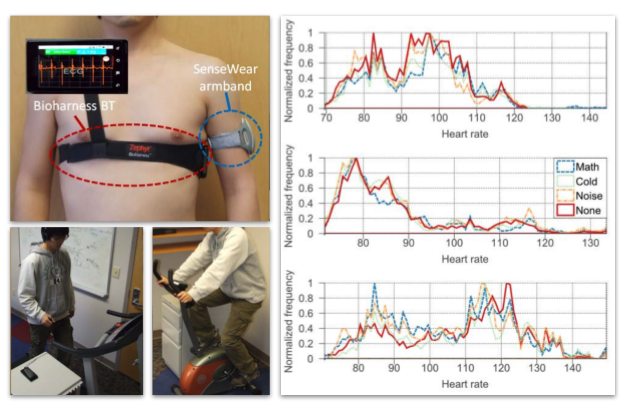
Physiological signals can help detect stress, but physical exertion changes many of the same signals, including heart rate and breathing rate. A method that works while someone is sitting may therefore fail when they walk or cycle. The challenge was to recognize stress when the person’s physical activity was not already known.
We studied how stressors and exertion affect these signals, then developed a clustering-based recognition approach that accounts for physical exertion before classifying stress. This separates changes associated with activity from the stress response the model is trying to detect.
Understanding the signals
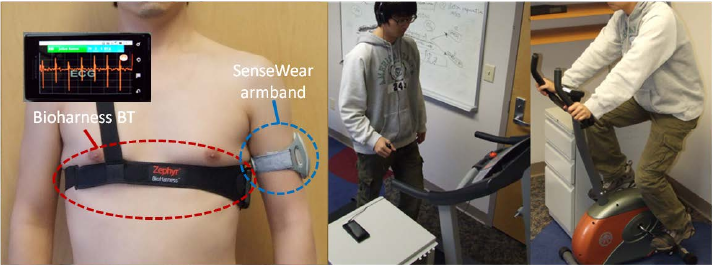
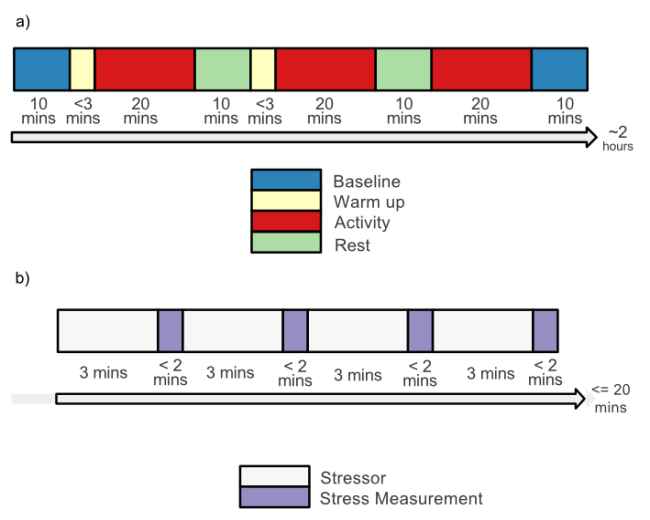
The work first examined physiological responses across physical activities and levels of exertion. The study included 20 participants performing three activities at varying intensities, with three types of stress-inducing stimuli.
Accounting for exertion
The model first clusters physiological observations into groups associated with physical exertion, then applies stress classification within that structure. This lets the recognition process account for exertion without requiring a known activity label for each observation.
Related publications
Full list →- Stress Recognition—A Step Outside the Lab
International Conference on Physiological Computing Systems · 2014