Mobile Health Interventions
Adapting the timing and content of mobile health recommendations using sensor data and human feedback.
The research hypothesis
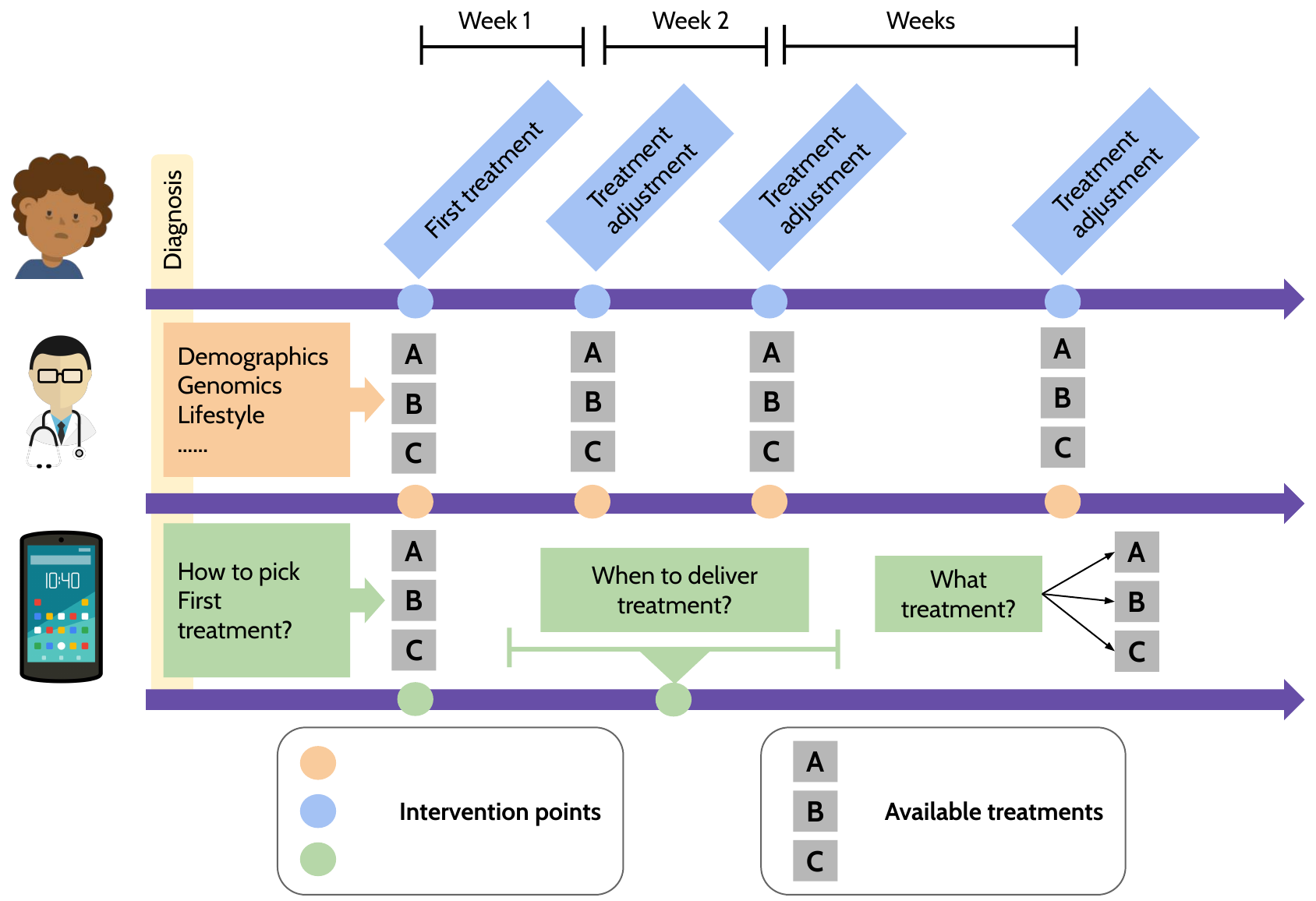
Personalizing a health intervention often involves trying advice, observing its effects, and adjusting it at a later appointment. Mobile devices can shorten that feedback loop, but the intervention must decide both what advice fits the person and when they can act on it, using limited individual data.
My hypothesis was that a mobile intervention could use sensing, AI, and user feedback to adapt both recommendation content and timing. The thesis tests this idea with separate, coordinated models that respond to behavior and context. SleepU is the system I built to study whether this approach could support adherence and behavior change.
SleepU · Doctoral thesis
Sleep advice needs to fit a person’s routines and leave them a realistic opportunity to act. To study this in everyday life, I designed, built, and evaluated SleepU, an Android intervention that learns on device from wearable sensing, sleep diaries, and user feedback. The thesis contributes:
- Timing and content personalization. Combined mobile-receptivity detection with contextual bandits to adapt when advice arrives and which recommendation is selected.
- An end-to-end intervention. Built the app, sensing and feedback pipeline, and evaluated the system in two real-world deployments.
- Evidence about adherence. Examined how context, motivation, and delivery mechanisms influence whether people follow advice.
- Adherence prediction. Developed and evaluated machine learning models using recent behavior, prior adherence, and context.
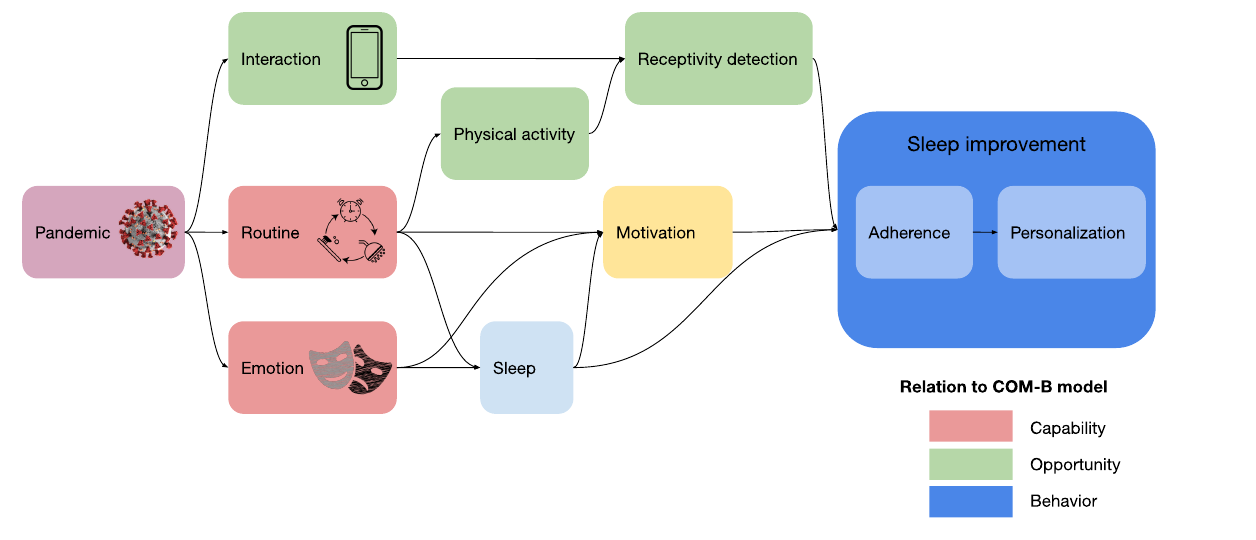
- A disruptive-events framework. Connected changes in routines, emotions, and device use to the breakdown of personalization during the COVID-19 pandemic.
Learning what to recommend—and when
Advice can be relevant yet arrive at the wrong time, while a well-timed reminder can still offer advice that does not fit. Learning both decisions from limited data requires a design that can adapt without waiting for a large personal training history.
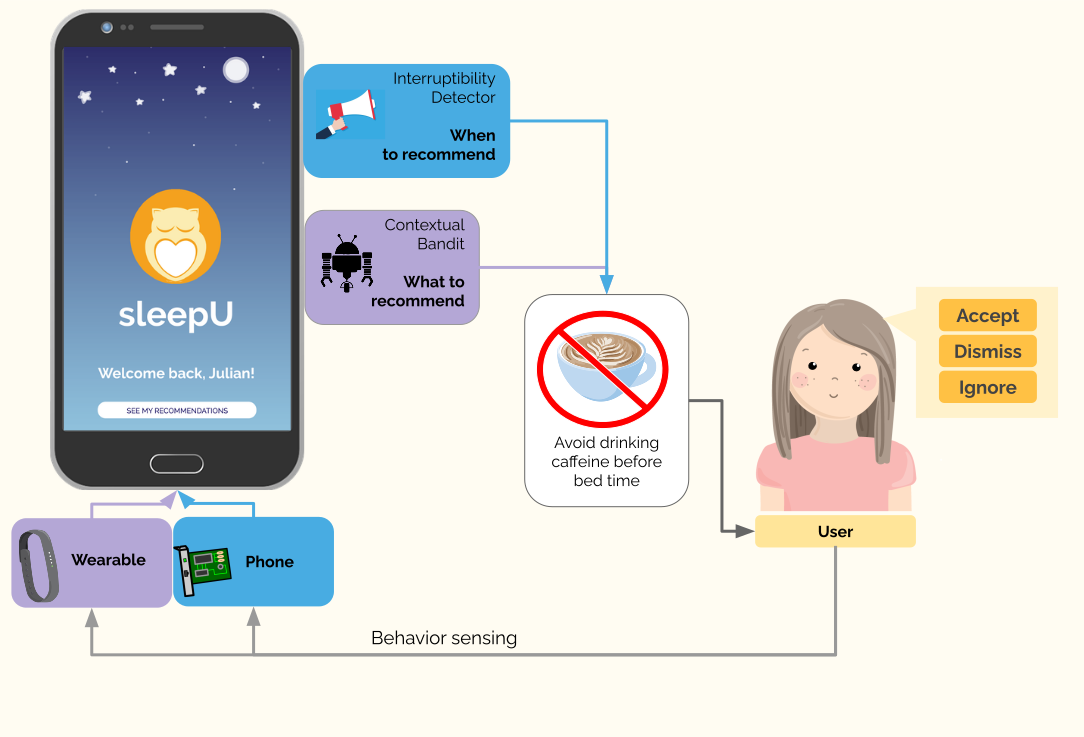
SleepU combines a contextual bandit that selects sleep advice using sleep outcomes and reported adherence with a mobile-receptivity detector that identifies opportunities to deliver reminders. Behavior-change models informed the design, and all personalization ran on the phone.
Testing SleepU in daily life
In 2019, Carnegie Mellon undergraduates took part in a study that lasted about 12 weeks. Participants wore a Fitbit to measure sleep and used their own Android phones. Thirty students completed the study.
Everyone began with about four weeks of monitoring to record their usual sleep without an intervention. They then completed two four-week phases: one using SleepU and one following a personalized sleep plan from a clinician. Participants were randomly assigned to start with either the app or the clinician-guided phase.
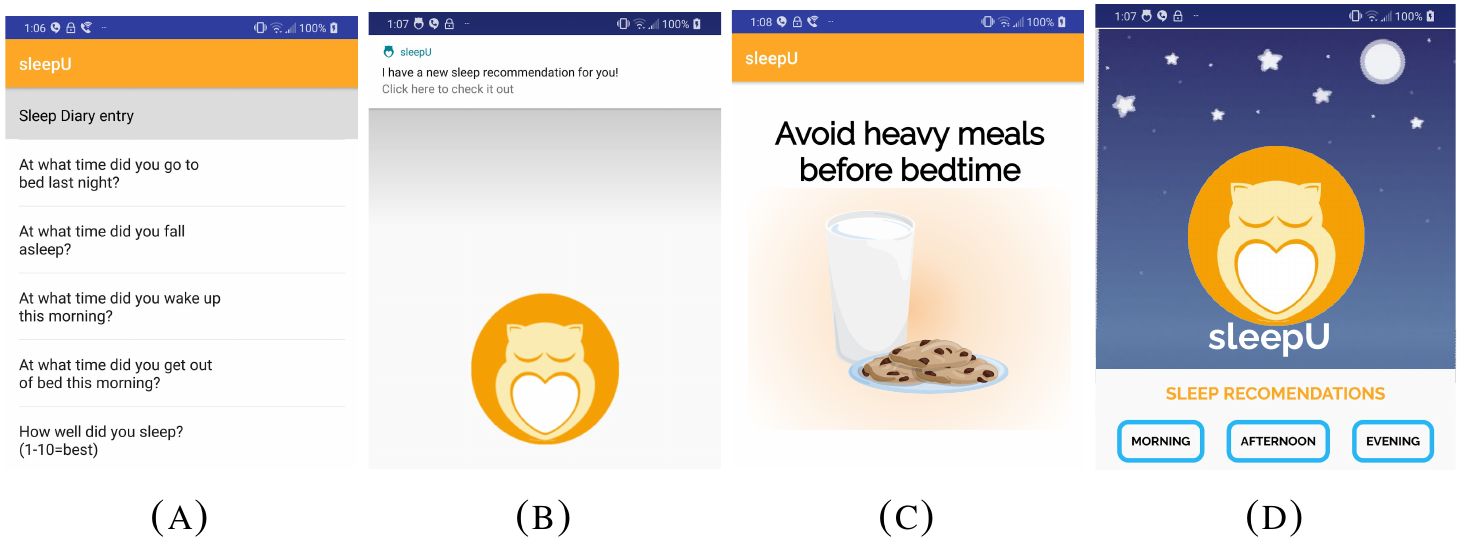
During the app phase, participants filled out a daily sleep diary. SleepU used their sleep data and feedback to select up to three recommendations per day and sent notifications to prompt them to read the advice. The next day, participants reported whether they had followed it. We compared sleep and motivation across phases and examined how recommendation timing affected adherence during app use.
Results from the 2019 study
Among the 23 participants with enough data for the sleep analysis, the app phase averaged 23 minutes more sleep per night than baseline and 15 minutes more than the clinician-guided phase.
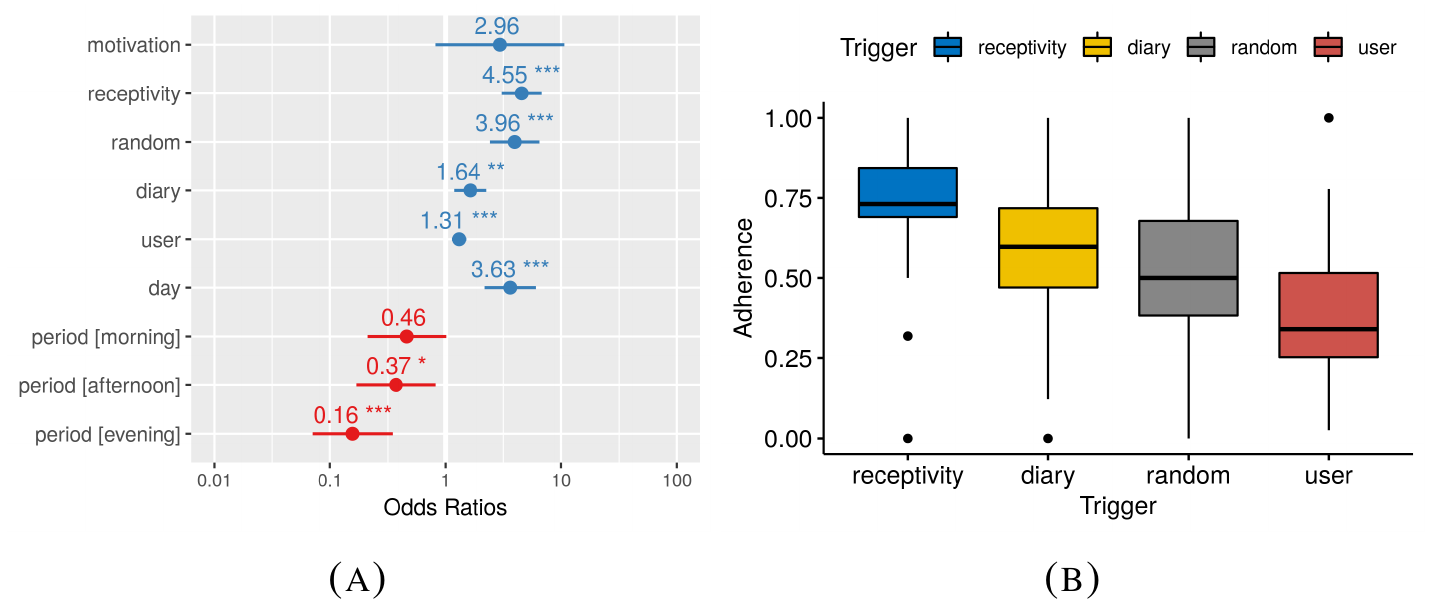
Receptivity-triggered recommendations also showed higher adherence than randomly timed recommendations. The thesis examined how context and motivation affected whether participants followed the advice.
Predicting whether advice will be followed
Being available to read advice does not mean someone will follow it. To extend personalization beyond receptivity, I developed an intraday adherence-prediction model that estimates whether a participant would follow sleep advice at different times of day.
The model used recent adherence, time of day, baseline sleep patterns, previous-day step counts, and cognitively demanding activity before bed. Training labels came from participants’ reports of whether they followed the previous day’s advice. The dataset contained 1,158 observations from 19 participants, with an average of 20 days of data per person.
I started with 40 candidate inputs and selected the most informative features. For the neural-network pipeline, I scaled the inputs and balanced the training examples. A multilayer perceptron achieved a mean F1 score of 0.755 in five-fold evaluation, with different participants in the training and test sets.
This offline evaluation explored adherence prediction as a further input to personalization. The goal is to identify periods when someone may need more support to follow advice.
| Model | F1 score | Balanced accuracy |
|---|---|---|
| Uniform-random baseline | 0.563 | ≈0.500 |
| Majority-class baseline | 0.768 | 0.500 |
| Multilayer perceptron | 0.755 | 0.703 |
| AdaBoost · 7 estimators | 0.766 | 0.660 |
| AdaBoost · 20 estimators | 0.793 | 0.645 |
| Elastic net · class-balanced training | 0.721 | 0.676 |
When routines break
In 2020, 72 students completed a seven-week follow-up study. After one week of monitoring, they used SleepU for six weeks. One group received AI-selected recommendations; the other received randomly selected recommendations. Each participant tried both notification schedules—random timing and receptivity-based timing—in separate three-week phases.
The follow-up began just before COVID-19 pandemic restrictions took effect and did not reproduce the earlier behavior-change results. Comparing the deployments and participants’ accounts revealed changes in routines, emotions, and phone use that disrupted opportunities to act on advice.
I developed the disruptive-events framework to explain how those changes affected receptivity, adherence, and personalization. It provides a way to reason about interventions when the context they depend on changes abruptly.
Earlier work: long-term activity recommendations
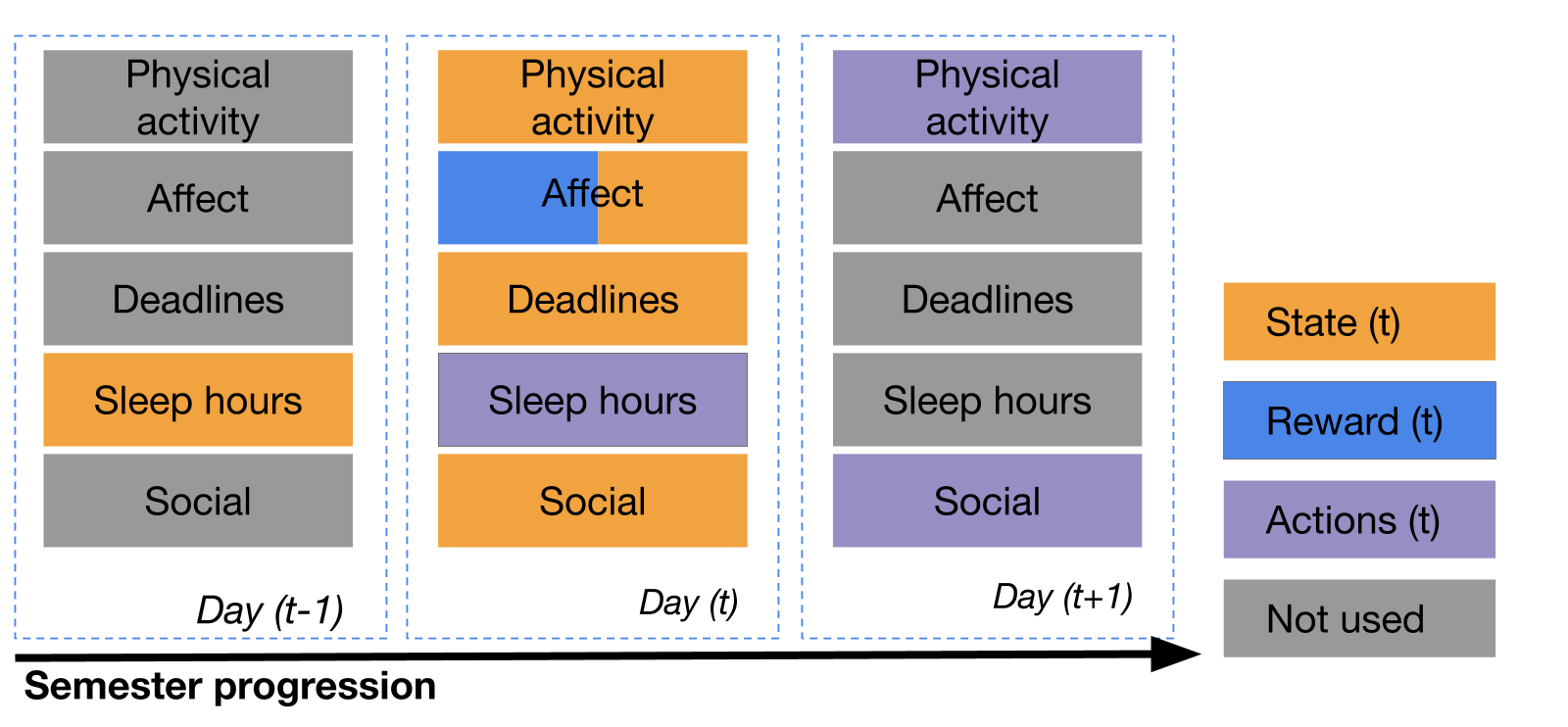
A recommendation can affect more than the next action, so selecting activities also requires considering their longer-term effects. Before SleepU, I adapted Q-learning to explore relationships between daily behavior, mood, and energy in the StudentLife dataset. The amount of data needed for learning helped motivate the more sample-efficient approach used in SleepU.
Related publications
Full list →- Exploring AI-based personalization of a mobile health intervention and its effects on behavior change, motivation, and adherence
Ph.D. dissertation · Carnegie Mellon University · 2021
 Activity Recommendation: Optimizing Life in the Long Term
IEEE PerCom · 2020